
Choose a window box when seeing specific contents without opening is a buying requirement; choose a closed carton when that view adds no useful inspection value. For private label building toy packaging, neither format alone proves better protection. Approve the complete packing arrangement—retail box, closures, inner supports and shipping carton—against a recorded sample comparison. A window reveals only the contents within its sightline, while hidden parts, quantities and internal restraint still require opening and checking.
Here, “closed carton” means the retail pack without a viewing window. The outer shipping carton is a separate layer and needs its own measurements, count, strength specification and shipping-mark checks. Keep the two approvals connected, but do not mistake approval of the retail artwork for approval of the shipping pack.
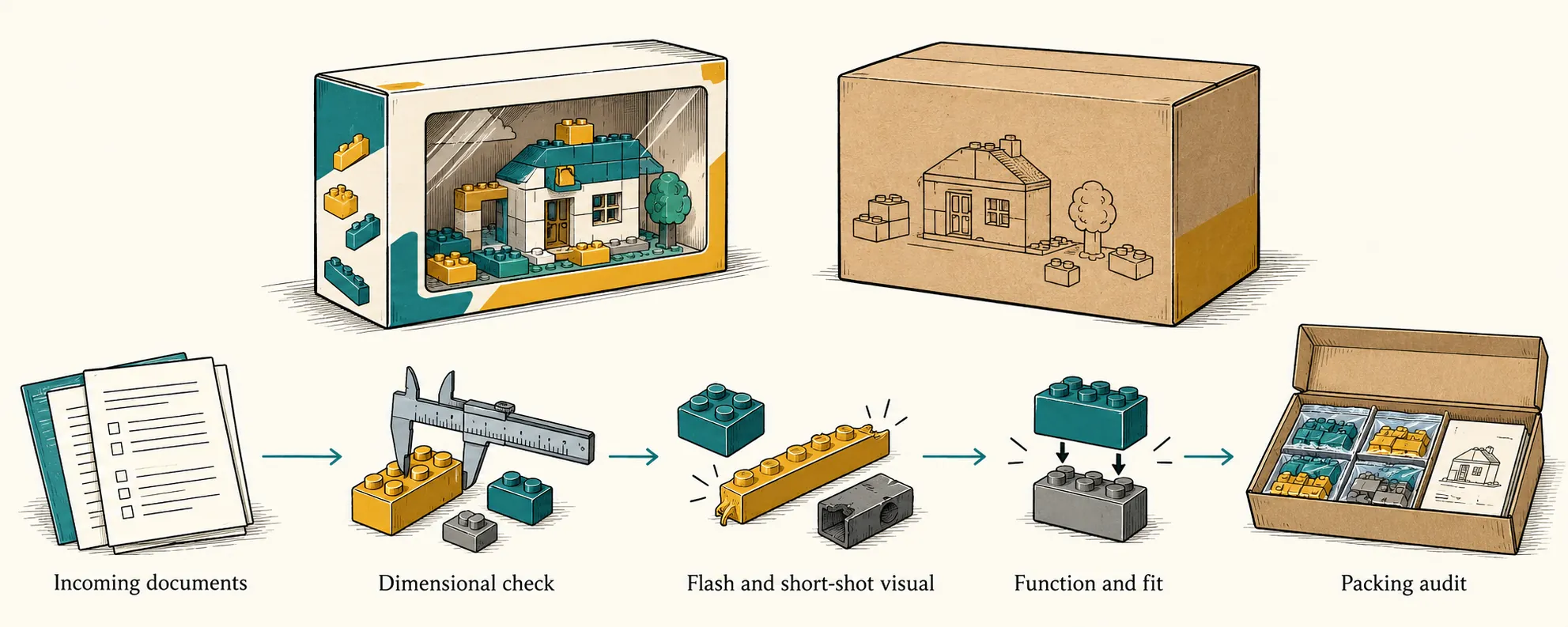
What Should You Compare on Window Boxes and Closed Cartons?
Compare both formats for the same building-set SKU and contents revision, using the rows below as the working record. Enter a specified target and an observation for each format; distinguish supplier-declared construction from what the inspector actually measured or saw.
| Window presence, shape and coverage | Window box: record the opening location, shape and dimensions in millimeters, plus the panel area if percentage coverage matters. Closed carton: confirm the approved panels have no viewing aperture. Compare each sample with its packaging drawing; an altered opening or panel needs revision review. |
|---|---|
| Window material and attachment | Record the supplier-declared material and thickness, then inspect the attachment perimeter for gaps, lifting edges, wrinkles or tears. Visual inspection does not identify the polymer or establish thickness. For a closed carton, inspect the corresponding panel and seams against the approved construction. |
| Contents visible without opening | List exactly which parts, bags or assembled display elements are visible through the window. Record glare, obstruction and movement out of view. A closed carton provides no direct view of its contents; printed product images are not observations of the packed set. |
| Instructions and hidden contents | Record whether the actual instruction booklet is visible, then open both samples and compare its revision and all contents with the current parts and packing lists. Seeing a booklet cover or one bag through a window does not verify completeness. |
| Closures and inspection access | Identify tuck flaps, tape, glued seams, seals or other closures. Record which closure must be disturbed to inspect the contents and whether opening leaves visible damage. Do not describe either format as resealable until the actual closure has been opened and reclosed. |
| Inner support and part restraint | After opening, compare trays, dividers, bags and support positions with the packing drawing. Record displaced bags, unsupported display pieces or parts contacting the window. Review any difference before approving the packing arrangement. |
| Printed panels and labels | Compare both formats with their approved artwork revisions. Check that the window, folds and closures do not obscure required buyer information, product identification or barcodes. Record print damage separately from damage to the contents. |
| Condition after the agreed routine | For each sample, record new scuffs, creases, window-edge separation, closure damage and contents movement against receipt photographs. State the handling steps performed; do not convert these observations into a transit-damage rate. |
How Do You Compare Samples Without Confusing Packing Damage With Handling Damage?
Use the same documented handling sequence for both formats, and preserve a before-and-after record. This reduces handling differences as an explanation for what you observe; a small sample comparison cannot isolate every cause or establish shipment performance.
1. Establish the comparison. Request the same SKU, parts-list revision, instruction revision and contents quantity in both formats. Identify every sample and packaging revision. If trays, bagging or supports also differ, record that you are comparing two complete packing arrangements—not just the presence of a window.
2. Record receipt condition before opening. Photograph the shipping carton, shipping marks, closures and visible damage, then photograph each retail pack as it is removed. Keep affected samples identifiable. A box that arrived crushed cannot provide a clean baseline for damage supposedly caused later on the inspection bench.
3. Perform the unopened checks first. Under comparable lighting, inspect all faces, closures and the window perimeter where present. Lift each pack, place it on the same clean surface and turn it through the same recorded orientations. Agree on any repetition count before starting; it is a buyer-defined screening condition, not an industry standard.
4. Open through the intended access point. Use the same inspector, work surface and tool policy for both formats, while respecting their different closure designs. Photograph a closure before breaking or cutting it. Keep cutting tools clear of contents and window edges so inspection does not create the damage being evaluated.
5. Reconcile and reclose. Compare the contents with the parts list, instructions and packing diagram. Return every bag, divider and booklet to its specified position, then reclose each pack as designed. Record whether an original seal was consumed, a replacement was applied or the pack can no longer represent an unopened retail unit.
6. Compare the final condition with the baseline. Identify when each discrepancy first became visible and who observed it. If handling departed from the agreed sequence, flag that sample and repeat the comparison with a fresh matched sample where the deviation could affect the decision. Do not simply attribute every new mark to the box format.
What Does the Comparison Establish About Protection?
The comparison establishes visible condition under the recorded routine, not resistance to drops, compression, vibration or an entire distribution route. A sound-looking window attachment and intact closed panel are useful observations, but neither is a measured protection result.
Treat a torn window, opening seam, shifted divider or displaced bag as a discrepancy to investigate against the agreed target. Correct the construction or packing method, then review a revised sample. Choose the closed format if the window provides no required view; retain the window only when its inspection or presentation function justifies the additional construction to control.
Where distribution protection is a release requirement, agree on a suitable packaging-performance evaluation for the complete packed configuration. Keep product-safety testing as a separate release decision: this buyer handling routine does not certify safety or determine age suitability.
What Must You Check on the Closed Shipping Carton?
Check the final closed, packed shipping carton against the approved packing specification and reconcile shipment totals with the final packing list. Before the purchase order, label dimensions, weights and quantities as proposed packing data; replace those estimates with final packed measurements before shipment approval.
Catalog quantities belong to their exact product and packing configuration. For example, the October 9, 2026 catalog records list 48 units per carton for the 148-piece flower building set and 36 for the 60-piece dinosaur marble-run set. Those are configuration-specific references—not interchangeable counts, order multiples or final shipment confirmation.
| External dimensions and units | Record: approved external L × W × H and final measurements of the closed, packed carton, using clearly stated centimeters or millimeters. Discrepancy: an unexplained unit conversion, bulging panel or measurement outside buyer-agreed tolerance. Decision: remeasure, check the packing layout and obtain acceptance of any consequential change. Keep internal fit dimensions separate. |
|---|---|
| Carton count and units per carton | Record: packing specification, physical count for inspected cartons and final packing list. Discrepancy: extra or missing retail units, mixed configurations or an unrecorded partial carton. Decision: recount the affected packing group, correct the packing or documents, and reconcile the shipment total. |
| Gross and net weights | Record: agreed weight definitions, packing specification, scale readings in kilograms and final packing list. Discrepancy: a reading outside the agreed tolerance or a net-weight figure using a different definition. Decision: verify the scale, tare basis and contents before correcting the pack or accepting a revised figure. |
| Carton strength and construction | Record: approved board grade, construction, joint and closure specification, plus the agreed strength evidence. Discrepancy: substituted construction, crushed flutes, split joints or a strength result below the specified target. Decision: hold packaging approval for review or correction. A hand squeeze is not a strength test. |
| Shipping marks and carton identity | Record: approved shipping-mark artwork and carton-number sequence. Discrepancy: wrong product reference, quantity, weight, destination identifier or unreadable marking. Decision: correct the marks and reconcile carton identities with the final packing list. Keep destination-specific paperwork in its own document review. |
| Packing arrangement inside the shipper | Record: approved carton packing diagram and retail-pack orientation. Discrepancy: a changed layer count, omitted divider or window face contacting an unintended surface. Decision: restore the approved arrangement or evaluate and approve the revised configuration before release. |
How Should You Calculate CBM for the Final Packed Configuration?
Calculate CBM from the shipping carton’s external packed dimensions, not from the retail-box size or an unlabeled catalog dimension. Use the final carton count and calculate separate groups when carton sizes differ.
Explicitly hypothetical example: a closed shipping carton measures 60 × 40 × 35 cm externally. CBM per carton = L(cm) × W(cm) × H(cm) / 1,000,000 = 60 × 40 × 35 / 1,000,000 = 0.084 m³. For 50 identical cartons, total volume = 0.084 × 50 = 4.2 m³.
If the final measurements differ from the pre-PO proposal, apply the agreed dimensional tolerance and review the effect on fit and total volume. A small accepted difference need not fail the shipment; an unexplained change should not be silently carried into the packing list.
What Must the Packaging Approval Record Contain?
Approve a named SKU and packaging revision, with the comparison attached and every condition assigned to an owner. The record supports traceability; it does not by itself prevent an undisclosed substitution.
| Identity and revision | Enter the SKU or product identifier, contents revision, packaging drawing and artwork revisions, sample IDs, sample dates and inspection date. |
|---|---|
| Specified target versus observation | For each comparison item, enter the approved requirement, supplier declaration where relevant, measured or observed result, and photograph or document reference. Identify the inspector. |
| Handling conditions | Attach the sequence performed, any buyer-defined repetition count, opening method, resealing method and deviations. Identify samples that arrived damaged or were altered during inspection. |
| Decision and conditions | Select window box or closed carton and state approved, conditionally approved or not approved. State the reason and whether the decision covers quotation only, bulk packing or shipment release. |
| Responsible approver and date | Name the packaging approver and decision date. Identify any separate commercial or shipment-release authorization required by the buyer. |
| Open items and follow-up closure | For each unresolved item, assign an owner, required evidence and deadline or release gate. Close it with the revised sample or record reference, reviewer and closure date; retain the previous revision. |
| Final packing reconciliation | Attach final external carton measurements, gross and net weights, units per carton, carton count, strength evidence, shipping-mark revision and reconciled packing list. |
Which Remaining Questions Affect the Packaging Decision?
Can a window replace opening the box for parts verification?
No. It can verify only what is actually visible. Open the designated inspection sample and reconcile hidden bags, parts, instructions and supports with the current packing records.
Does a “color box” description confirm a window?
No. A color-box packing label does not specify window presence, material, thickness or attachment. Request the packaging drawing and a sample of the exact proposed revision.
Should I approve a window when its material is not yet confirmed?
Do not give unconditional construction approval while the material remains unresolved. You may approve the visual layout conditionally, with material confirmation assigned to an owner and required before bulk packing.
Does a closed carton prevent inspection?
No. It prevents direct contents viewing while closed, but the designated inspection sample can be opened and reconciled. Record any broken seal or opening damage so the inspected unit is not mistaken for an untouched retail pack.
What if bulk packing differs from the approved sample?
Record the affected revision and scope, compare the change with the approved targets, and obtain a disposition from the named approver. An acceptable change can be documented and approved; a consequential unresolved change should hold the affected packaging release.