
Approve a botanical building kit rename only for a specific copy-and-artwork revision whose product claims and asset permissions have been reviewed separately. For botanical building blocks wholesale listings, choose a descriptive name, remove unsubstantiated character, brand, and compatibility references, and document permission for every retained image and instruction asset. Hold publication where a material review condition remains open. This is a purchasing approval process—not a legal clearance opinion, safety assessment, or certification of the kit.
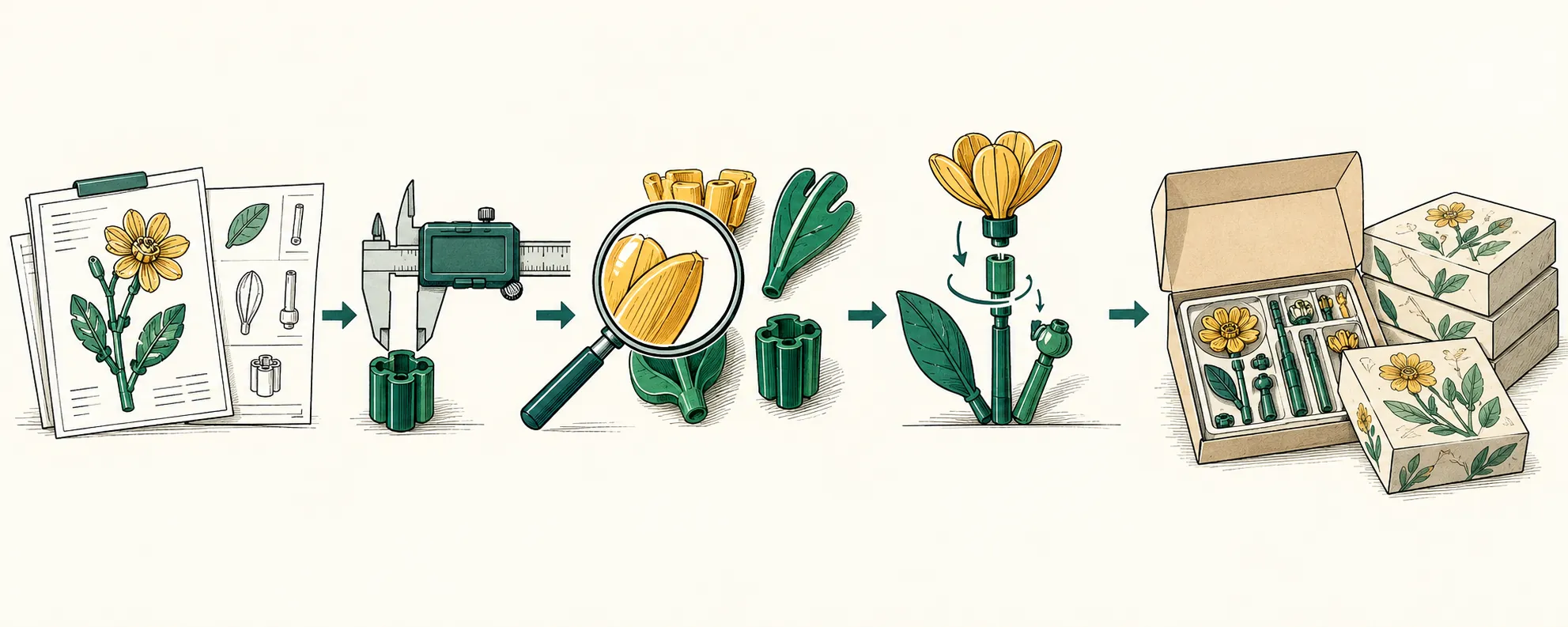
What Should a Neutral Rename Keep—and Leave Behind?
Keep supported descriptions of the kit; do not carry over another party’s identity, character associations, or accessory claims merely because they appear near the source listing.
“Potted Plant Building Kit” is a useful descriptive draft, not a cleared name. Add “four-plant,” plant varieties, or moving-feature descriptions only after checking the exact private-label configuration against current instructions, a parts list, or a matched sample. A seller’s description establishes what the seller says, not what the buyer has independently confirmed.
One marketplace listing describes four plants—plum blossom, orchid, bamboo, and chrysanthemum—with interchangeable, spinning heads and connectable hands. Its “Cartoon character” field contains plant names. A recommendation module on the same page includes a separate light kit described as compatible with a different brand’s model. These are distinct entries: the field label does not establish a licensed character, and the accessory statement does not establish compatibility with the botanical kit. Amazon.ca listing
Removing a name is not the same as reviewing the design. Faces, poses, printed parts, packaging illustrations, and instruction drawings still need attention. If the concern is the physical design itself, route it for a separate design-rights review rather than treating new catalog wording as the remedy.
Which Fields Belong in the Naming and Artwork Review?
| Proposed name and subtitle | Target: descriptive wording without borrowed identity. Record the exact spelling, capitalization, translations, and intended sales markets. Evidence: dated name-review record identifying searches, reviewer, scope, and disposition. Owner: buyer’s brand or legal reviewer. Condition: resolve flagged similarities before catalog release. |
|---|---|
| Character, brand, and collection references | Inspect the title, body copy, badges, packaging, printed parts, and instructions. Record any names, logos, catchphrases, character nicknames, or collection labels. Owner: catalog editor, with rights-review escalation. Condition: remove references outside the approved scope or document the basis for retaining them. |
| Product photographs and illustrations | Identify every retained asset by filename and revision. Request its creator or rights holder, the permission document, and the permitted uses, including editing, private-label publication, channels, markets, and duration where specified. Owner: artwork or rights coordinator. Condition: resolve the permission scope or replace the asset. |
| Instructions and diagrams | Review instruction text, assembly drawings, cover art, translations, and linked digital files separately from product photography. Record the relevant permission and any adaptation restrictions. Owner: instruction editor and rights coordinator. Condition: use only the reviewed instruction revision. |
| Product descriptions and feature claims | Match plant varieties, included builds, moving features, and any stated piece count to the intended configuration. Evidence: dated parts list, packing record, instruction revision, or identified sample observation. Owner: product buyer or technical reviewer. Condition: correct or omit unsupported optional claims. |
| Compatibility and affiliation wording | Search visible copy, image captions, search tags, file metadata, and digital links. Target: no unreviewed compatibility, endorsement, or affiliation claim. Owner: catalog editor. Condition: remove the claim unless a separate review supports its exact product and wording. |
| Age and safety-related text | Compare the proposed catalog wording with the product-specific labeling and destination-market review. Keep age positioning and hazard warnings distinct. Owner: product-safety reviewer. Condition: resolve conflicting statements; do not select an age from appearance, size, or build complexity. |
| Final publication package | Record the copy revision, image manifest, packaging proof, instruction revision, and destination channels. Owner: publishing approver. Condition: release only the identified package and review later substitutions before use. |
Which Draft Wording Should Be Kept, Revised, or Removed?
| “Potted Plant Building Kit” | Retain as a descriptive candidate. It identifies the product without adding a character identity or compatibility claim. Complete the name review and match the description to the intended kit before release. |
|---|---|
| “Four-Plant Building Kit with Spinning Heads” | Use only after configuration review. The reference listing makes these feature statements, but the private-label item still needs a matching parts list, instructions, or sample check. |
| “[Character nickname] Botanical Friends” | Hold if the nickname or depicted character identity has not been reviewed. Replacing the source brand while retaining a character-style identity does not complete the naming-and-artwork task. |
| “Compatible with [other brand]” | Remove from this neutral draft. Compatibility wording attached to another product or accessory is not evidence for the botanical kit. |
| New title over an unchanged source image | Hold the image pending its own review. A neutral title does not establish permission to reuse the photograph, illustration, packaging layout, or instruction artwork. |
What Would a Completed Hold Record Look Like?
| Identity and revision | Review subject: one proposed private-label potted-plant building kit. Proposed title: “Potted Plant Building Kit.” Package: copy revision A and its attached source-image set. The live record must also identify the buyer’s item reference and each image and instruction file. |
|---|---|
| Review date and scope | Exercise decision date: October 27, 2026. Scope: proposed English catalog name, copy, and image selection for US/EU publication. No legal-clearance, safety, or compatibility determination is included. |
| Specified target versus observation | Target: descriptive name, supported feature wording, and reviewed permission for retained assets. Observation: the proposed title contains no express third-party brand or compatibility wording; the feature text remains supplier-stated; asset permission has not been established within this exercise. |
| Decision | HOLD publication of revision A. Retain the descriptive title as a candidate, subject to name review. The hold concerns unresolved review conditions, not a finding of infringement or supplier misconduct. |
| Responsible approver and signature | Accountable role: buyer’s catalog-release approver. Before live use, enter that person’s full name, decision date, and signature or controlled electronic approval. Product, rights, and name reviewers supply their findings; the release approver records the combined decision. |
| Condition N — name review | Owner: buyer’s brand or legal reviewer. Due: before publication. Closure evidence: dated review of the exact candidate name and intended markets, with its disposition. Closure status in this exercise: open; retain the publication hold. |
| Condition A — asset permissions | Owner: artwork or rights coordinator. Due: before asset release. Closure evidence: permission tied to the retained filenames and intended use, or replacement assets with their own reviewed basis. Closure status in this exercise: open; do not publish the proposed source images. |
| Condition P — feature verification | Owner: product buyer or technical reviewer. Due: before final copy approval. Closure evidence: match the feature wording to current instructions, a parts list, or an identified sample; otherwise remove the optional feature claims. Closure status in this exercise: open. |
| Final closure entry | For each condition, record the evidence reference, accepted revision, reviewer’s full name, closure date, and outcome. The release approver then issues a dated approve, hold, or reject decision for the resulting package. |
When Should the Buyer Approve, Hold, or Reject?
Approve when the required reviews are complete for the identified package; hold when a material condition remains unresolved; reject a proposed name or asset when the review determines it should not be used.
Do not mark a package approved merely because its conditions have owners. If unresolved images can be replaced, review the replacement package and issue a decision against that new revision. Rejection of one image need not mean rejection of the entire kit.
A sample inspection can confirm visible wording, printed graphics, included parts, or a demonstrated mechanism on that sample. It cannot establish who owns artwork. Likewise, a permission document does not verify the kit’s contents. Keep those evidence types separate.
The record supports traceability. It does not by itself detect an undisclosed artwork substitution or establish legal clearance, compliance, age suitability, or cross-brand compatibility.
Which Remaining Questions Affect the Rename Decision?
Can we approve the name while artwork permission remains unresolved?
You can record acceptance of the name as a separate review finding, but keep the combined publication package on hold. State that the name finding does not authorize the images, instructions, packaging, or physical character design.
What should we do if the supplier cannot document permission for the artwork?
Hold the affected assets and request a documented basis for the intended use. Alternatively, commission replacement photography or artwork and review its permissions and depicted content separately. New photography does not settle concerns about an underlying design.
Does a plant name in a “Cartoon character” field mean the kit is licensed?
No licensing conclusion follows from that field alone. Treat it as catalog metadata, inspect the actual depiction, and review any character identity or permission claim separately. Do not turn a marketplace field label into “official,” “licensed,” or similar private-label copy.
Which age should we copy if the source page gives different ages?
Copy neither automatically. The reference listing has a manufacturer-minimum-age field of 180 months, or 15 years, while marketing wording says 12 and up. Route the discrepancy to the product-safety reviewer and use product-specific labeling and destination-market review to resolve the proposed wording. A neutral rename does not settle age suitability. Amazon.ca listing