
For brick, magnetic, and buildable-track assortments, request missing packing fields against one identified product variant and approve only when the response matches the agreed packing specification. Your building toy carton packing specifications should distinguish component counts, sellable sets, inner packs, and master cartons—not merge them into a single “quantity” field. Send a field-by-field request with evidence requirements, then record the supplier’s reply, verification result, and buyer decision against the same revision.
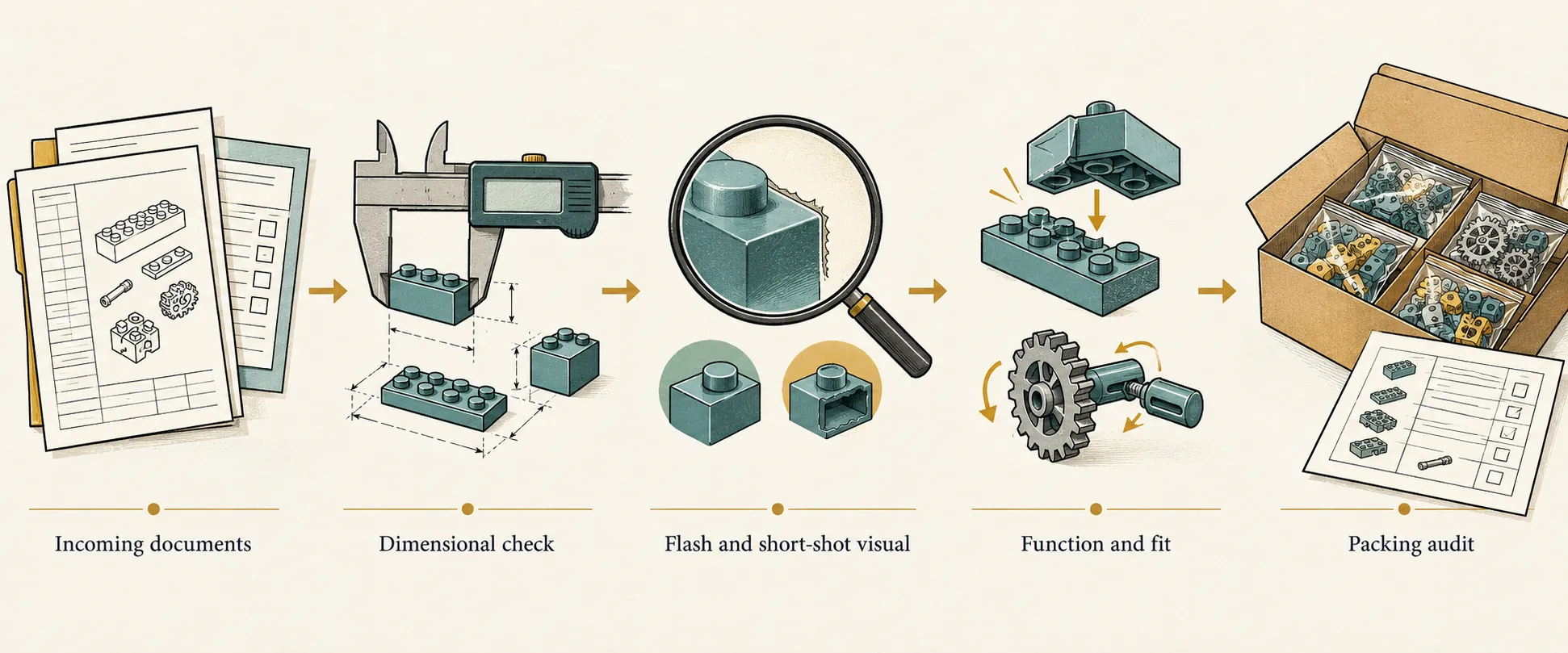
Which product and variant should the packing request identify?
Identify the construction mechanism, exact variant, and assortment role before requesting packing details, so the supplier answers for the set you intend to buy.
Use Brick Building Sets, Magnetic Building Toys, Large Building Blocks, Marble Run Building Sets, or Creative Construction Toys as the assortment category. Classify magnetic construction tracks under Magnetic Building Toys; use Marble Run Building Sets for non-magnetic buildable tracks. Keep theme, age designation, and piece system as separate attributes.
Attach the supplier’s item reference, a product image, the selected piece-count and color variant, and the quotation or specification revision. State whether the item is a standalone set or an add-on. Ask for close-up connection photos and a component layout when the name alone does not establish the mechanism or contents. One shared product name is not enough to identify several packing variants.
What should the field-by-field packing request ask for?
| Connection mechanism and selected variant | Request: “Confirm the connection mechanism and the exact variant covered by this packing sheet. Identify any differences from the attached image or quotation.” Evidence: labeled product photos, connection close-ups, and the matching item/variant reference. |
|---|---|
| Piece inventory | Request: “List each component type, its quantity, and any bag grouping. State whether accessories and spare pieces are included in the advertised total.” Evidence: component inventory and a laid-out sample photo. Reconcile the inventory with the stated piece count. |
| Sales unit | Request: “Define one sellable unit: one complete set, one individual component, or one multipack. List everything included in that unit.” Evidence: contents list linked to the retail pack and quotation. |
| Retail packaging | Request: “Confirm the retail packaging type, packed external length × width × height in centimeters, and gross weight in kilograms for one sellable unit.” Evidence: photos of the packed unit, dimension measurements, and scale reading. |
| Inner pack | Request: “State whether an inner pack is used. If yes, give sellable units per inner pack, packaging type, packed external dimensions, and gross weight.” Evidence: open and closed inner-pack photos. If no inner pack is used, confirm that explicitly. |
| Master-carton quantity and assortment mix | Request: “Confirm sellable units per master carton and inner packs per carton, where applicable. State whether cartons contain one variant or a mix; for mixed cartons, list the quantity of each variant.” Evidence: carton packing layout and packing list tied to the selected revision. |
| Master-carton dimensions and weights | Request: “Provide external length × width × height in centimeters for the closed shipping carton, plus carton net and gross weight in kilograms. Define what the net weight includes.” Evidence: measurements and scale photos of the packed carton. Identify any parcel measurements separately. |
| Instructions | Request: “Provide the instruction file, language version, revision, and delivery format. Confirm the number of printed copies per sellable set, or explain how digital instructions are accessed.” Evidence: instruction file and sample pack. Review legibility and whether the component list supports the illustrated build. |
| Packing approval evidence | Request: “Return a dated packing sheet identifying the item, variant, and revision, with matching sample and packaging evidence. Explain any differences from the quotation or previously reviewed sample.” Evidence: linked files and a clearly identified sample, reviewed against the buyer’s target specification. |
What does a 140-piece large-block catalog record establish?
| Listed piece count: 140 | Status: confirmed as a catalog description. Request: “Provide the component inventory totaling the advertised 140 pieces, identifying accessories and spares.” Approval check: compare the inventory and selected sample; do not interpret 140 pieces as 140 sellable units. |
|---|---|
| Packing type: color box | Status: confirmed as a catalog entry. Request: “Confirm that one color box contains one complete selected set and show the packed contents.” Approval check: match the box, variant, contents, and instructions. |
| Carton quantity: 12 units | Status: confirmed as a catalog entry; sales-unit meaning still needs confirmation. Request: “Confirm whether these are 12 complete retail-boxed sets and state any inner-pack arrangement or variant mix.” Approval check: reconcile the carton layout with the defined sales unit. |
| Recorded size: 50 × 10 × 37 cm | Status: dimensions are recorded, but the packing level needs identification. Request: “Identify what this measurement describes and provide separately labeled retail-pack and master-carton external dimensions.” Approval check: match each measurement to the photographed pack; do not copy this size into both fields. |
| Recorded weight: 2.0 kg | Status: weight is recorded, but its packing level and net/gross basis need identification. Request: “Identify what the 2.0 kg covers and provide the requested retail-unit and master-carton weights with their definitions.” Approval check: compare the labeled values with the corresponding packed sample. |
How should the supplier request be worded?
Send a request that names the exact variant, separates the unresolved fields, and tells the supplier how to return a usable response.
Subject: Packing-field confirmation — [item reference] / [variant] / [specification revision].
“Please complete the attached field-status worksheet for the identified variant by [date and time zone]. For every requested field, enter your exact answer, units, packing level, response date, and evidence file reference. Show any change from the attached specification explicitly rather than replacing the earlier value without explanation.
Please identify whether each dimension and weight applies to the retail pack, inner pack, master carton, or shipping parcel. Define ‘unit’ wherever a quantity is given. Where a field does not apply, state why. Return the revised packing sheet together with the labeled photographs, component inventory, and instruction file requested in the worksheet.
Packing approval remains pending until the required responses have been reviewed against the agreed specification and selected sample. Please flag any field that cannot be confirmed by the requested deadline.”
Do not derive MOQ from piece count, treat carton quantity as an order multiple, or infer master-carton dimensions from parcel dimensions. Those are separate commercial or packing fields.
When should the buyer approve, hold, or reject the response?
Approve the packing response when every required field is resolved against the identified variant and revision; hold unresolved required fields, and reject a proposed packing arrangement that does not meet the agreed requirement unless an authorized change is accepted.
For the large-block example, the recommended desk-review decision is hold packing approval until the sales-unit definition, measurement levels, weight basis, component inventory, and remaining required checks are resolved. That is a decision about the response—not evidence that the supplier cannot meet the specification.
Use this sign-off record: item/variant and revision; field or issue; specified target; supplier response/date; evidence reference; observed result and verifier/date; decision and reason; open condition; action owner and due date; responsible buyer approver/date; closure evidence and closure date. Close each condition explicitly instead of leaving “approved subject to confirmation” as the final status.
If a supplier changes carton quantity, dimensions, contents, or packaging after review, request the revised packing sheet and reassess the affected fields. Revision records support traceability; they do not by themselves reveal an undisclosed change.
Keep packing approval separate from destination-market safety review. Supplier-declared certifications are not verified compliance, and a successful count or carton measurement is not a safety test.