
Accept an inbound construction-toy lot only after its identity, connection mechanism, variant and component inventory match the approved order, its stock movements are traceable, and required release checks are complete. Hold unresolved discrepancies; reject confirmed, unapproved substitutions. For buyers sourcing building block sets wholesale, the Cubimana Island Storm recall shows why an LED battery component must be recorded separately from the theme or total piece count. Matching a catalog description alone is not a safety release.
The US CPSC recall dated March 5, 2026 concerns Cubimana Island Storm 3 In 1 Building Sets with LED Lights. Its component-specific hazard provides a useful receiving-review example—not evidence that any other supplier’s building sets are recalled. CPSC recall

Which Cubimana identity fields should receiving staff recognize?
The recalled product is identified by its name, model HG1004, 781 multicolored building pieces, black packaging with pirate-base and pirate-ship imagery, and LED light component. A pirate theme or a 781-piece label alone is not a reliable match. VitalLaw recall report
CPSC states that children can easily access button cell batteries in the LED light piece’s battery compartment. Swallowed button cell or coin batteries can cause serious injuries, internal chemical burns and death. That finding concerns the named recalled set; it does not establish that every LED component has the same defect. CPSC recall
Capture both the supplier’s printed model and your internal SKU. They serve different purposes: the printed model helps match a public notice, while the internal SKU links purchasing, receiving and warehouse records. Neither replaces the received lot identifier.
Which catalog differences change the receiving check?
| 60-piece dinosaur marble-run building set | Catalog ID: CPS270921. Listed piece count: 60. Packaging: color box. Recorded units per carton: 36. Receiving recommendation: verify the track and block connections on the approved sample; classify it as Marble Run Building Sets if the buildable track is non-magnetic. Match the received parts to the approved inventory rather than relying on the dinosaur artwork. |
|---|---|
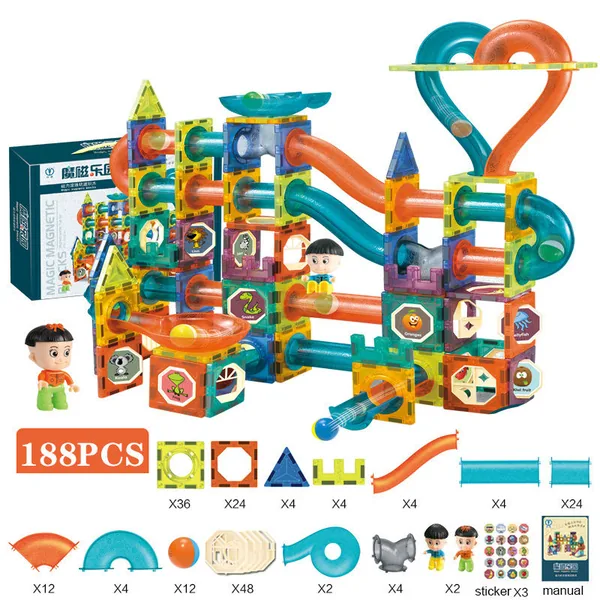
| 188-piece magnetic marble-run track set | Catalog ID: CPS243968. Listed piece count: 188. Packaging: color box. Recorded units per carton: 8. The catalog describes magnetic bricks and plastic pipe track components. Place a verified magnetic-track configuration in Magnetic Building Toys, and record its actual magnetic components separately from pipes, balls and other accessories. |
How should stock, color, logo and packaging choices be approved?
Choose the unchanged, approved configuration when the order does not need a different color mix, logo or box; treat each requested change as a separately approved variant. A catalog image or listed color does not confirm inventory or immediate shipment.
Request a quote naming the exact SKU, complete-set sales unit, component inventory, color assortment, logo treatment, box artwork and instruction revision. Confirm current availability and whether reorders will retain that configuration. For customization, obtain the MOQ and lead time for that specific change rather than carrying over a base-product MOQ.
Keep set piece count, carton quantity and order MOQ in separate fields. Carton quantity is a packing attribute, not automatically an order multiple. At receiving, check the actual carton contents against the order and packing list; do not derive master-carton dimensions from product or parcel dimensions.
Does the same component profile mean the same recall applies?
A comparable component profile triggers a focused review; it does not make a different product part of the Cubimana recall. Determine recall applicability from the named product’s identifiers and the notice’s scope, then assess any separate concern about another SKU on its own evidence.
Keep magnetic cubes, magnetic rods and balls, magnetic tracks, and LED-equipped brick sets distinct in the record. Rods are not tiles, and a non-magnetic brick is not a magnetic cube. Theme, age labeling and piece system remain separate attributes rather than substitutes for connection mechanism.
Use the five assortment categories—Brick Building Sets, Magnetic Building Toys, Large Building Blocks, Marble Run Building Sets and Creative Construction Toys—alongside a more precise mechanism field. Magnetic tracks belong in Magnetic Building Toys; non-magnetic buildable tracks belong in Marble Run Building Sets. For the Cubimana example, inspect the LED or battery-containing component if one is present. Shared pirate imagery cannot transfer a battery-compartment finding.
What should the inbound lot traceability record contain?
| Record identity and revision | Assign a receiving record ID and revision; link the purchase order, supplier, delivery reference, receipt date and approved specification revision. Preserve the history of later corrections. |
|---|---|
| Product identity | Target: exact internal SKU, ordered product name and approved supplier model. Observation: transcribe the model or item number from the received box and photograph the identifying panels. |
| Verified variant and mechanism | Target: approved color assortment, connection system and variant. Observation: record the actual configuration and any difference from the approved sample, including logo or artwork changes. |
| Piece inventory and component list | Target: approved total and component-by-component inventory. Observation: record the inspected set’s counts and part types, explicitly addressing LED pieces, battery-containing pieces, magnetic components, balls and track parts. |
| Sales unit and received quantity | State what one ordered unit contains. Record ordered and received quantities, carton count, observed units per carton and inspection coverage independently of the number of pieces inside a set. |
| Packaging and instructions | Target: approved box description, artwork revision, labels and instruction version. Observation: record packaging condition, printed identifiers and booklet version. Check that the inspected set’s instructions correspond to its supplied parts and approved build configurations. |
| Approval and documentation evidence | Link the approved sample, specification, inspection findings and relevant reports. Label supplier declarations as declarations; separately identify any report reviewed and the construction or variant it covers. A declared certification is not verified compliance. |
| Lot and date codes | Transcribe supplier lot and date codes exactly and photograph their locations. Assign an internal receiving-lot ID linking the delivery and physical stock. If no supplier code is printed, record that observation without inventing a manufacturer batch. |
| Stock location and movements | Record receiving, quarantine and released-stock locations. Link quantities moved, split, repacked, picked or dispatched to the original receiving lot, with movement dates and transaction references. |
| Decision and authorization | Select accept, hold or reject; state the evidence-based reason, release conditions, responsible approver and decision date. Preserve any separate quality or safety hold. |
| Follow-up and closure | Assign an owner and due date for each unresolved condition. Record corrective evidence, final disposition, quantities reconciled, closing approver and closure date before changing the lot’s status. |
When should receiving accept, hold or reject a lot?
Accept only when the delivery meets the approved receiving criteria and an authorized person releases it; hold when a consequential question remains unresolved; reject when an unapproved discrepancy is confirmed and the lot is not authorized for acceptance.
A practical hold example is an LED piece found in a delivery whose approved component inventory contains no lighting component. Record the observed addition, segregate the lot and require a component-level review before release. Do not describe that delivery as recalled merely because the Cubimana notice also concerns an LED piece.
Reject a confirmed wrong model or unapproved component substitution unless the buyer formally approves a revised disposition after the necessary review. Missing paperwork alone does not establish dishonesty or prove a defect, but it can leave a specified release condition unsatisfied.
These are purchasing controls, not laboratory safety tests. An inventory count, assembly check or signed receiving form does not by itself demonstrate regulatory compliance or reveal an undisclosed construction change.
How should a later notice be traced through stock?
Match the notice to product identity first, then use receiving-lot and movement records to locate the relevant stock. Search printed models as well as internal SKUs, because relabeling or packaging changes can leave the supplier model outside the warehouse’s usual search field.
The Cubimana notice does not provide lot codes. An internal receipt date therefore cannot, by itself, exclude a matching HG1004 set from the recall. Use your lot records to locate stock—not to narrow the notice beyond its stated scope.
For a confirmed or unresolved match, block allocation and picking, identify physical locations, reconcile quantities and assign the review to a named owner. Follow the applicable recall instructions for the named product and document the stock disposition. CPSC’s stated consumer remedy for this recall is to stop use, remove and properly dispose of the batteries, discard the product and submit a disposal photo for a refund; it is not a universal warehouse disposal procedure for unrelated sets. CPSC recall
Close a non-match review with the identifiers and evidence that distinguish the product, not simply “different theme.” Traceability supports locating and segregating stock; its value comes from accurate records maintained through each movement.