
Approve a building set’s traceability plan only when it connects the retail-box identity, production lot and exact document revisions through explicit matching keys. For US/EU-bound orders, building kit component traceability should also connect the finished set to the component lots used in assembly or packing. Before the purchase order, approve the specification, draft artwork and matching rules; after production, reconcile actual lot records and shipment quantities. A matching record chain supports traceability—not a blanket finding of product safety or compliance.
Use the framework below as a purchasing control. Keep destination-specific legal review separate rather than treating a generic test report as evidence for every configuration. In each reconciliation row’s item-and-destination field, record the destination and approved market version. For any potentially applicable destination obligation, verify its requirements and applicability from primary official sources, such as the official legal text and responsible regulator’s guidance. Record the source name, link, relevant provision or version, verification date and reviewer alongside the applicability conclusion. If verification is incomplete, mark it as an open exception rather than assuming the obligation is satisfied; record any resulting approval restriction.
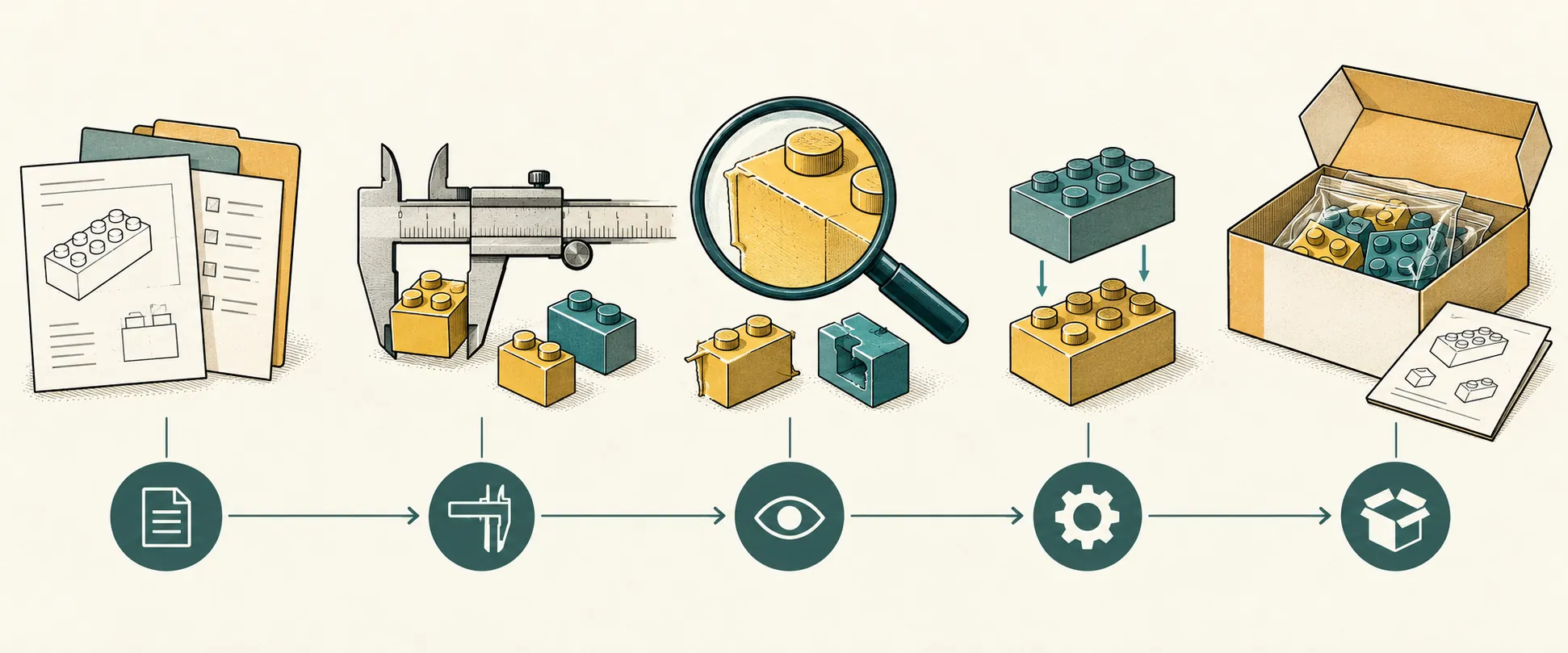
Which identities must connect from a retail box back to its components?
The traceability chain needs three linked identities: the sellable box, the production lot and the controlled document baseline.
The box identity combines the buyer and supplier item references, GTIN where assigned, pack configuration, destination version and artwork revision. A GTIN identifies a trade item; do not use it alone as the production-lot key. Keep the box’s visible lot marking, or its documented equivalent, in the matching record.
The lot identity needs a factory/site identifier, lot code, production or packing window and quantity unit. Pair the site identifier with the lot code so identical local codes from different sites do not merge accidentally. Connect this finished-set lot to component receipt lots, bagging or subassembly lots, and packaging issues through the production record.
The document baseline is an approved list of document identifiers and revisions: parts list, instructions, artwork, specification and applicable safety-document references. Its reference belongs on the production or packing record. A folder containing the latest files is not enough; the buyer needs the versions assigned to that lot.
Which records should be reviewed before the PO and after production?
| Product specification and parts list — before PO | Owner: supplier engineering or product team; buyer approves the purchasing baseline. Useful fields: buyer/supplier item cross-reference, revision, component identifiers, descriptions, color/material specifications, quantity per set, spare-parts policy, bag allocation and pack configuration. Mismatch consequence: the advertised piece count may match while the actual component mix differs; resolve the baseline before approval. |
|---|---|
| Instructions and draft retail artwork — before PO | Owner: supplier document-control or packaging team; buyer approves the destination version. Useful fields: document identifier, revision, language version, model options, parts inventory, GTIN where assigned, piece-count claim, marking locations and artwork approval date. Mismatch consequence: instructions, contents and box claims can describe different configurations. |
| Controlled document index and change register — before PO, maintained through shipment | Owner: supplier quality/document control. Useful fields: document identifier, revision, approval date, applicable item/configuration, effective lot or production window, superseded revision and change authorization. Mismatch consequence: a current file cannot establish which version was used for an earlier lot. |
| Safety-document coverage register — before PO, reviewed when changes occur | Owner: buyer compliance lead, supported by supplier quality and the document issuer. Useful fields: destination, report or declaration reference as applicable, issue date, tested model/construction, relevant components and materials, report amendments and explanation of item-reference differences. Mismatch consequence: the document may not support the ordered construction; resolve coverage separately from ordinary quantity checks. |
| Coding and record-linkage plan — before PO | Owner: supplier production/quality team. Useful fields: site identifier, lot-code format, marking location, component-to-finished-lot linkage, carton allocation method and document-baseline reference. Mismatch consequence: the buyer may receive readable codes without a usable route back to production and document records. |
| Component issue, production and packing records — after production | Owner: supplier warehouse, production and quality teams. Useful fields: actual component receipt lots, issued and returned quantities, subassembly/bagging lots, finished-set lot, site, production window, document baseline, packed quantity, rejects, rework and retained samples. Mismatch consequence: the finished-set lot cannot be reliably connected to the recorded component population or quantity disposition. |
| Final packing list and shipment allocation — before shipment release | Owner: supplier shipping team, checked by buyer receiving/logistics. Useful fields: PO reference, item cross-reference, carton identifiers, retail units per carton, lot allocation, destination and shipped quantity. Mismatch consequence: the production record may be correct while the shipment-to-lot allocation remains unresolved. A final packing list is not a pre-PO requirement. |
Which fields belong in each lot-to-box reconciliation row?
| Record identity and revision | Assign a reconciliation-record identifier and revision; record the PO reference and review stage. Link later corrections to the preceding record rather than silently replacing it. |
|---|---|
| Item and destination | Target: approved buyer/supplier item cross-reference, US or EU destination, market/language version and sellable-unit definition. Observation: identifiers and configuration shown on the sampled box and supporting records. |
| Retail-box identity | Target: approved GTIN where assigned, artwork identifier/revision, piece-count claim and pack configuration. Observation: scanned or transcribed identity, box photographs, artwork-production reference and sample identifier. Artwork revision may be established through controlled print records rather than visible retail text. |
| Finished-lot identity | Target: agreed lot-code format and marking location. Observation: actual box/carton code, factory/site identifier, production or packing window and production-record reference. Verify the documented relationship between box and carton codes; do not assume they are identical. |
| Component genealogy | Target: approved component identifiers, quantities per set and required lot-linkage detail. Observation: actual receipt lots, issue records, bagging/subassembly references and allocations to the finished lot. Record authorized substitutions against the relevant change reference. |
| Document-version linkage | Target: approved baseline identifier and its parts-list, instruction, artwork and specification revisions. Observation: baseline referenced by the lot record and the actual files or printed inserts reviewed. |
| Quantity reconciliation | Target: agreed unit of measure and accounting boundary. Observation: component issues/returns, packed sets, shipments, stock, samples, rejects and documented losses or adjustments. Cross-reference the supporting records and explain any residual difference. |
| Evidence and matching result | Separate direct observations, supplier-record statements and buyer conclusions. Record sample selection, evidence references, field-level matches, conflicts and any limits on what was inspected. |
| Decision and closure | Record approve, approve with conditions, or do not approve; define the scope, open exceptions, action owner, due date, responsible approver and decision date. Add closure evidence, recheck result and closure approver/date. |
How do you check quantities and document revisions without double-counting?
Reconcile finished sets and individual components separately, then check that each production allocation points to the document baseline used at the time.
For finished sets, choose a clear boundary and date: opening stock plus newly packed sets and documented returns should equal shipments, closing stock, samples and other documented removals. Separate released stock from held stock. Do not count a retained sample again as closing stock if it already appears in a separate disposition category.
For components, reconcile opening stock and receipts against issues, returns, closing stock and documented removals. Then reconcile components issued to packing against parts incorporated into sets, work in progress, returns, scrap and samples. Compare component consumption with the approved quantity per set; do not compare a total measured in individual bricks with a shipment quantity measured in retail sets.
A four-in-one car-and-truck set advertised as 1,276 pieces needs more than a matching total. Check the quantities by component identifier, the approved bag allocation and the instruction options. Establish whether alternative builds use a shared parts pool before interpreting the box claim. Neither the advertised total nor the model count establishes the observed contents of a sampled box.
For version control, compare the lot’s baseline reference with the issued parts list, packed instructions and artwork-production records. Check changes against their effective lot or production window. A dated approval is useful, but the date alone does not establish which revision reached the packing line.
What does a completed traceability review look like?
A completed review states the required configuration, the observed match, the remaining exception and the decision authorized for that specific stage.
Hypothetical example—not a supplier or customer record: a car-and-truck building set is assigned illustrative identifiers “Lot A,” “Box A” and “Baseline A.” The approved baseline references “Parts A” and “Instructions A.” During a post-production review, the selected box carries Lot A, its packaging-production record references Box A, and its packed instruction leaflet matches Instructions A. The component issue schedule links the approved component identifiers and receipt lots to Lot A.
The reviewer finds that the shipment allocation does not distinguish Lot A from another finished lot. The appropriate result is a match for the reviewed box/document linkage, with shipment allocation still open—not a rejection of every piece of evidence and not approval of shipment traceability.
An illustrative approval note would “Item: car-and-truck building set; reviewed combination: Lot A / Box A; document baseline: Baseline A, including Parts A and Instructions A. Result: selected box and production-document references match; shipment allocation requires correction. Decision: approve the reviewed document baseline, withhold shipment-traceability approval. Action owner: supplier shipping lead. Closure: revised carton-to-lot allocation checked against the packing record. Responsible approver: buyer quality lead; decision date, action due date and closure date entered when signed.”
When should the buyer approve, conditionally approve or require correction?
Approve only the scope actually supported: a pre-PO record plan, a production-lot reconciliation and a shipment allocation are different approval decisions.
Before the PO, approve the controlled specification, draft packaging, document baseline and agreed coding/linkage method. Future lot numbers and final shipment quantities can remain scheduled deliverables with named owners and review gates; do not fabricate them to make the form look complete.
Require correction when two actual records conflict on a key identifier, component allocation or applicable revision. Preserve the original record and link the correction to it. A missing field should be recorded as an open exception in the working review, not inferred from a similar product or the newest file in a folder. Its significance follows the affected control: a missing artwork revision does not erase a valid physical piece-count observation.
Use conditional approval only when its boundaries are explicit. For example, approval of draft artwork must not be mistaken for approval of the final packed lot. Name the action owner, required evidence and stage that cannot proceed until closure. Close the condition by checking the corrected field and its linked records—not merely by receiving another attachment.
Which remaining questions affect the approval decision?
Does every later production batch need a new test report?
Do not use a new lot number alone as the reason to demand a new report. Review the tested construction and report coverage, subsequent changes, applicable retest duties, and buyer or retailer policies separately. Keep that assessment distinct from checking whether the actual batch is linked to its production records.
Does a different internal item code automatically invalidate a report?
No. Request a documented cross-reference between the ordered item and the tested model, then compare construction, components, materials and configuration. A code cross-reference explains identity; it does not establish that materially different products share report coverage.
Can an outer-carton lot code replace the box-to-lot connection?
For this purchasing framework, require a documented route from the retail box to the lot even when a carton code is used in warehouse records. A carton-only relationship may be lost after unpacking unless the unit identity or another retained record preserves it. Assess any destination-specific marking obligation separately.
What does a successful sample match actually establish?
It establishes consistency among the sampled units and records reviewed, within the stated scope. A physical count is an observation; a production log is supplier-record evidence; the approval decision is the buyer’s conclusion. The match does not establish that every unit is identical, detect every undisclosed change, or replace safety testing and destination-specific assessment.